








Hear the stories of the first people to kayak West Virginia’s steepest whitewater November 6 in a Morgantown pre-release screening of Freeland: A Blackwater Story.
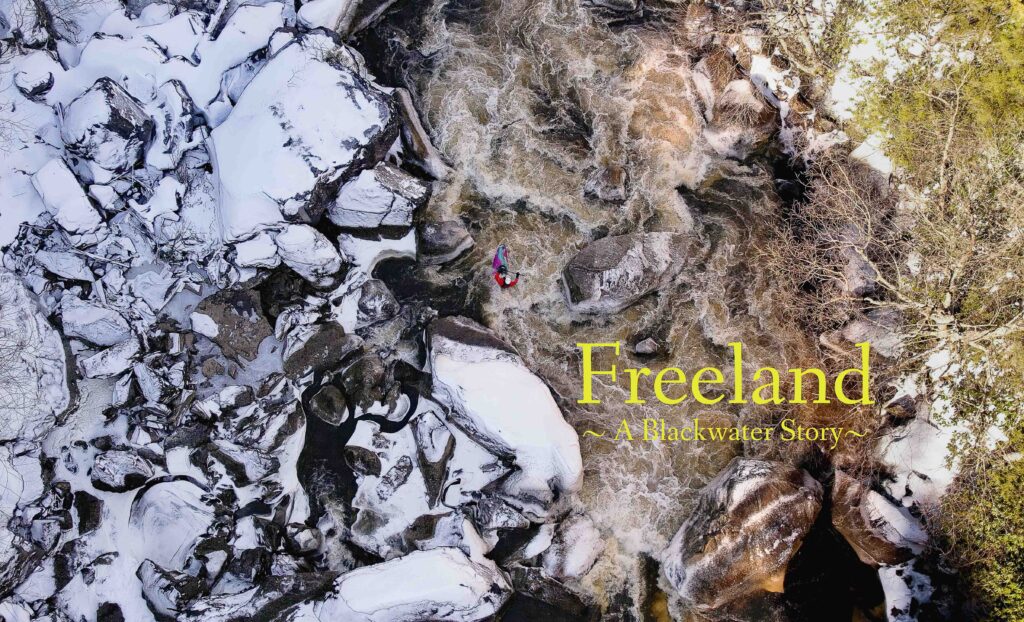
People come from around the world to boat West Virginia’s New and Gauley rivers. Those rivers are the center of commercial whitewater rafting in West Virginia, and the gradients in some of the most exciting sections average 40 feet per mile (fpm) and more—as high as 80 fpm in the Gauley’s “Big 5” class V rapids.
But in the elite and dangerous sport of steep-creeking, gradients can be 100 and even over 200 fpm. These are remote and highly technical runs, long series of crashing waterfalls and massive boulders that a boater can get sucked under or flipped and wedged between.

West Virginia’s steep creeks are coveted badges for boaters at that level of skill—but who had the guts to go first? Those people are the subject of the new documentary film Freeland—A Blackwater Story by Justin Harris and his company, Mountain River Media. You can see the film in a Morgantown pre-release screening on November 6.
Harris wasn’t always a filmmaker. A photographer and content creator, he moved with his wife to Canaan Valley, West Virginia, in 2018. He found himself living in “the mecca of whitewater”: between Otter Creek, with a gradient of over 100 fpm; Red Creek, where the upper section drops at 126 fpm; and the Blackwater River—descending a thrilling 241 fpm in its upper section, just below Blackwater Falls. “In this region, there is a very fine line drawn in the sand,” Harris says, “and it’s who’s run the Upper Blackwater and who hasn’t.”
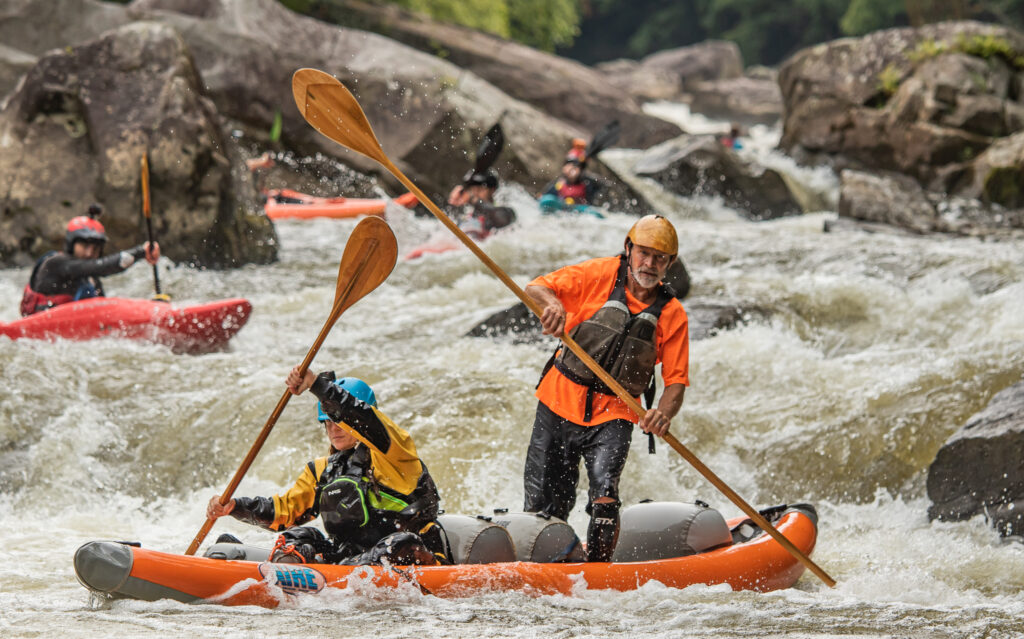
Boating on steep mountain creeks is only possible after a sudden spring melt or an extraordinary rainstorm, so Harris started a YouTube channel to showcase rare runs. His first video shows a 2019 run of Otter Creek, which a local told him hadn’t been run since Superstorm Sandy in 2012. His channel became popular. “Most of the kayakers on the Eastern Seaboard were watching us, because they knew we were running things people wait decades to run.”

In May 2022, a storm washed hard through Red Creek. “That’s literally like Narnia to us—it’s very, very hard to catch,” Harris says. “That day, we had 36 people among six groups run it, which was just unheard of for Red Creek.” He gathered GoPro footage and combined that with drone shots and a Zoom interview with a geologist friend about what makes this terrain special. When he posted The Red Creek Sessions on YouTube, friends encouraged him to enter it into documentary film festivals. “A year and a half later, we’d won 47 awards,” he says, still sounding amazed. “That’s how I became a filmmaker.”
He followed that in 2023 with the award-winning Freeland: A White Grass Story, the story of Canaan Valley’s much-loved White Grass Ski Touring Center, told through interviews with its founder and devotees. He saw White Grass as the “yang” counterpart to the “yin” of a Blackwater film to follow—Freeland Run is the waterway between the ski slopes and the river. “Most likely, if you ski White Grass and two days later kayak the Blackwater, it’s the same water,” he says.
And that led to the Blackwater film.
He’d been thinking about it since his five years at Precision Rafting in Friendsville, Maryland, a company started in 1981 by paddlers Roger Zbel and Phil Coleman. “Sitting around at the shop, I’d hear the stories of what they had done back in the day,” he says. “For years, in the back of my mind, I was like, ‘Somebody’s gotta record this, or we’re going to regret it.’ After Red Creek Sessions came out, I was waiting for somebody else to do it. I did not feel that I was worthy of telling that story—I’m not at the top echelon of whitewater boating.”
But Harris found himself with the right skills, meeting the right people—the pioneers of steep-creeking in the Potomac Highlands, the ones who had made the first descents and named the rapids four decades earlier. He filmed them telling stories about a 1980s culture of excitement and discovery. “Dan Sullivan and Ben McKean were riding around in an old Toyota pickup with a topo map, just picking off first descent after first descent,” he says of those days. “Roger Zbel and John Regan, they were the stars—they got video up early, doing international trips and getting into magazines, and they deserve that recognition. Dan and Ben were more low-key.”

Harris tracked down 1980s and ’90s camcorder footage of the early descents. “I always wanted to design a film that combined this new storytelling that we use, with drones and big cinematic effect, with old-school.” He found 42 hours of VHS tapes, much of it Regan’s. And after five years accumulating footage for the film, he finally persuaded the biggest holdout, Jeff Snyder, to talk with him. “It’s the first interview he’s done in 21 years. I showed him a part of the film I had made, and that’s when he agreed.” In the film, the real-time footage, narrated by the boaters’ vivid rapid-by-rapid recollections of their descents, brings the energy of the 1980s to life.
With the thrill of steep-creeking comes peril, and the film addresses death on the Blackwater and on whitewater in general. “I’ve lost four friends, all four close to me, and also witnessed two people drown in front of me,” Harris says. “That list is heavy—most have not lost that many friends. But it’s a warning to the younger generation, who aren’t thinking about that.”
What comes through overwhelmingly in the film is respect—for the power of the water and for the ones who, using gear many generations earlier than today’s, dared to go first. “Telling that story in this film, that’s probably the greatest honor of my whitewater career,” Harris says.
After two intense years on the film festival circuit, Harris entered Freeland—A Blackwater Story into a smaller number of more elite festivals this year, and he was honored that it was selected for inclusion in the Crown Point International Film Festival in Chicago, the Santiago Mountain Film Festival in Santiago, Chile, and the Chagrin Documentary Film Festival in Chagrin Falls, Ohio, among others. Blackwater took the River Kayak award in the Waterwalker Film Festival.
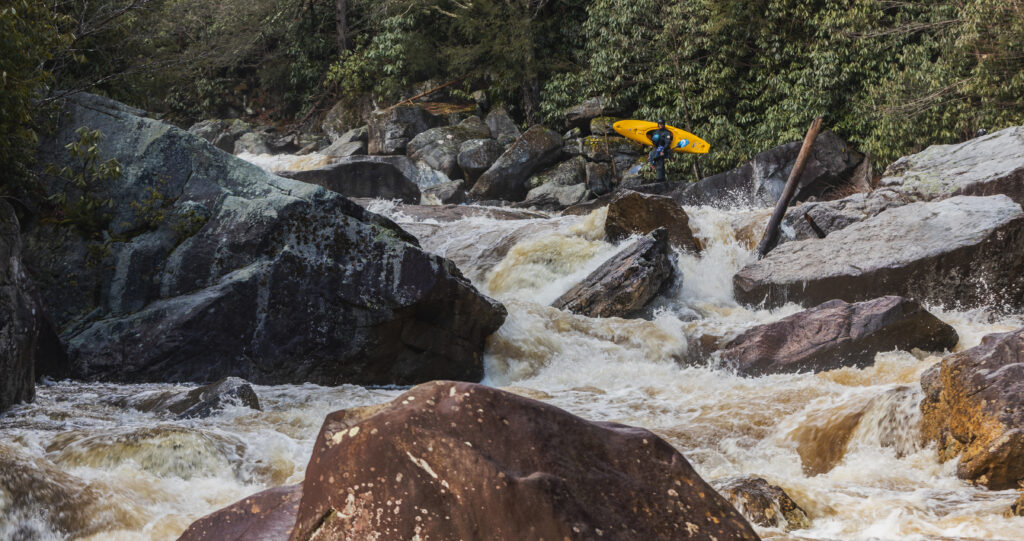
Freeland: A Blackwater Story will be released on YouTube in March 2026. The Morgantown screening takes place on Thursday, November 6, at 7 p.m. in the Media Innovation Center at Evansdale Crossing. The hour-long screening is free to WVU students; the general public is asked for donations to support Adventure WV, a WVU program that provides outdoor experiences for students and the community.
Harris will be on hand for the screening, and the evening includes a preview of Mountain River Media’s first collaborative project, to be released in 2026: a partnership with WVU to document and support the River Field Studies Network river-based education project.
READ MORE ARTICLES FROM MORGANTOWN LOWDOWN

Leave a Reply