








The huge and highly competitive federal RETI Consortium grant WVU won in July may be the beginning of a major increase in university research activity. What would that mean for Morgantown?
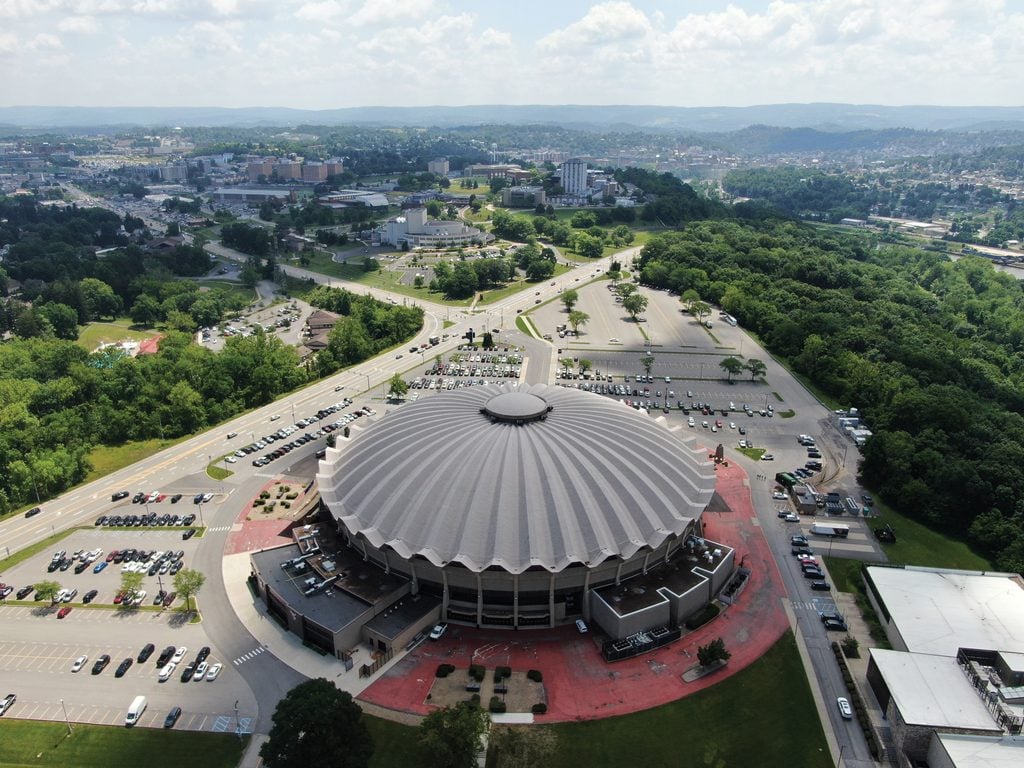
Last fall, WVU President Michael Benson presented a vision of seeing the university on the roster of the elite Association of American Universities. He acknowledged it as a “stretch goal,” and it is: The university would probably need to double its federal research funding while raising its profile on the national stage in many other ways.
The growth that would follow would make the university’s goal a stretch for Morgantown, too.

What is the AAU?
In 1900, 14 U.S. universities teamed up to form the Association of American Universities to standardize American doctoral programs and elevate their reputation worldwide. Its members generate a prodigious volume of transformative research, innovation, and education—addressing national and global challenges while training future leaders and problem-solvers.
Of the 542 U.S. universities that award research doctorates, 187 are classified Carnegie R1 “very high activity” research institutions, including WVU. Only 69 of them—13%—are in the AAU. But that small group is mighty: It typically wins more than 60% of competitively awarded federal funds for basic research and issues half of all research doctoral degrees.
Membership is by invitation only. The AAU doesn’t have specific criteria, but
looks for steadily high research throughput, faculty achievement, and doctoral degree completions.

Most relevantly for Morgantown, the communities AAU universities occupy are not so much college towns as innovation hubs anchored by universities—and that transformation imposes growing pains.
Hosting a Fast-Growing University
No two universities and towns are perfect comparisons, but lots of land grant universities in small cities are growing their research operations, benefitting and challenging their host cities in the process. In one illustrative example, Virginia Tech set out in 2000 to join the ranks of the nation’s foremost universities, and the result today is a world-class tech and life sciences research and startup ecosystem. The influx of scientists and the booming entrepreneurial environment have invigorated the city and made for a steadier year-round economy. At the same time, Blacksburg, population 45,000, and the surrounding area struggle with housing affordability, transportation, and municipal services.
But with good planning and communication, Russ Rogerson believes Morgantown could really benefit from growth in WVU’s research operation. “From an economic development perspective, having an R1 institution is good,” says Rogerson, who brings a long community development background to his role as president and CEO of the Morgantown Area Partnership, “but having one that is doing even more research is even better, because there’ll be a lot more research and technology and potential businesses that can spin off.”

The community is in a good position with regard to commercial space in and near town, he says, and the I-68 Commerce Park at the airport will open in the next five years.
He acknowledges challenges, too, with housing, in a town perennially short of options, at the top of the list. The Partnership is already taking advantage of the state’s BUILD WV tax incentives for residential development, and housing has hit the federal government’s radar as a national issue, too. “Housing is key to our future,” Rogerson says. “There’s not a silver bullet, but it really relies on that becoming a focus locally, at the state level, and federally, and I believe we’re well on our way in that journey.”
Developing infrastructure is an active and ongoing process, he says. “Good water and sewer service, a strong electricity grid and natural gas, and preparing land for development, those are challenges that growing communities address.”
Morgantown is well-positioned to navigate the challenges. The Partnership formed in 2019 specifically to bring economic and community development efforts under one umbrella. Today, it’s a hub for communication and collaboration with WVU and with city, county, and state partners—and that will allow the city to shape the process rather than just going along for the ride. “We need to maintain who we are and not lose our identity,” Rogerson says. “How do we become a better version of ourselves? That’s done through that collaboration.”
With planning, Morgantown can look forward to some real upsides. “A strong job base—that’s the lifeblood of any community,” he says. “That allows for better housing, better shopping options, better parks, better roads, better everything—the kinds of services and amenities that people like.”
What’s Next
The university has momentum. Research spending has averaged $235 million over the past five years, up from $184 million over the previous five. Two professors were elected to the prestigious National Academies in 2024. And the 217 research doctorates WVU awarded in 2024–25 is a university record.
Benson also points to the NSF Engines grant that was awarded to the WVU-led Resilient Energy Technology and Infrastructure Consortium in July 2026. “This is a $160 million grant, our biggest ever, and we are the principal investigator, in partnership with Carnegie–Mellon and Pitt,” he says. Private funding from dozens of local partners raises the total to $321 million. This work of the RETI Consortium will enhance WVU’s stature as an industrial energy innovation hub and further its AAU momentum.
Whether the university eventually earns an AAU invite or not, Benson says the process is its own reward. “The quality of the institution will go up, and the better WVU does, the better our entire state does.”
Rogerson sees the same for Morgantown. “With good, managed growth comes wealth and the services and amenities that brings, and that’s paramount to the success of being a good community 20, 40, 50 years from now.”
Ramping Up
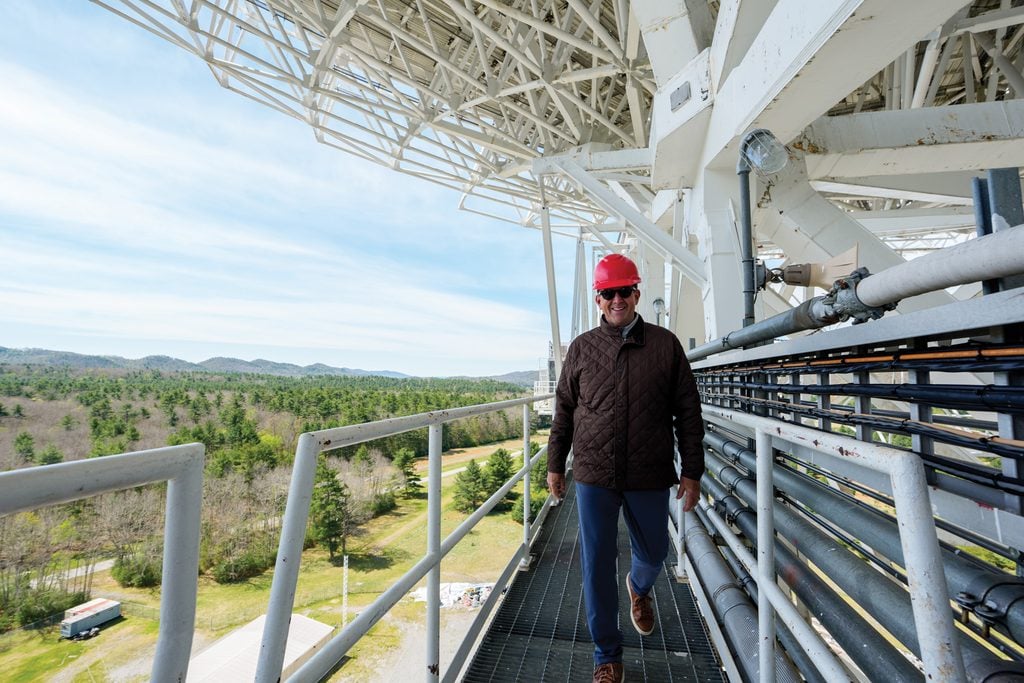
A year into his presidency at WVU, Michael Benson has just about finished assembling his leadership team, and he looks forward to the coming capital campaign.
As a historian who has studied the history of academia closely, Benson takes the land grant mission of teaching, research, and public service through extension seriously. WVU is his first land grant presidency and, in visiting the state’s 55 counties over the past year, he says he gained an appreciation for the role extension plays in every county and corner of the state. He also notes the importance of WVU Medicine’s critical-access hospitals in remote counties.
He’s excited about the leadership team he’s assembled. “I purposely wanted to hire a provost that was at the other end of the spectrum,” he says of Beverly Wendlund, who brings a science counterpoint to his humanities background. Fabrizio D’Aloisio, who grew enrollment at the University of Tennessee, Knoxville, is heading up enrollment management. “He is really laser-focused on how we’re crafting our message and how we’re going into neighboring states and trying to recruit as many kids from Pennsylvania and Ohio as well as West Virginia as we can.” Chris Kabourek, who came from Ohio State to serve as chief financial officer, “is already helping us with a whole host of issues.”
Asked about WVU’s challenges, Benson puts enrollment at the top of the list. “Higher ed has to make a better case of why it’s worth the investment,” he says. “College is not just about job training or that degree. It’s about life skills—getting along with other people, your ability to communicate. It’s about taking responsibility—balancing your checkbook and getting up on time. I’m a huge believer that you learn as much, if not more, outside the classroom as you do in it.”
He also names the changing environment of college athletics as an ongoing challenge. “I support revenue sharing and name, image and likeness.” But, he says, there have to be guardrails, citing unresolved matters of athlete eligibility in the NCAA. “We have to be able to know what the rules are.”
And he stresses the need to keep college affordable, underlining the transformative value of The Morrill Land Grant Act of 1862 and the GI Bill that made college possible for vast numbers of Americans. “Those things were based on public policies in our country that said, ‘Yes, we value higher education, and we value it so much that we’re going to help pay for it.’ That’s a wonderful legacy that we should all be very proud of.”
The university will unveil a major capital campaign in the fall of 2026. The last campaign, the 2012–2017 State of Minds campaign conducted under presidents James Clements and Gordon Gee, raised $1.2 billion, far in excess of its original goal of $750 million. The university is keeping details quiet until the launch, but Benson hints at “a moonshot.”
READ MORE STORIES FROM OUR FALL 2026 ISSUE

Leave a Reply