








Now is the perfect time to plan a trip for Black History Month or after.
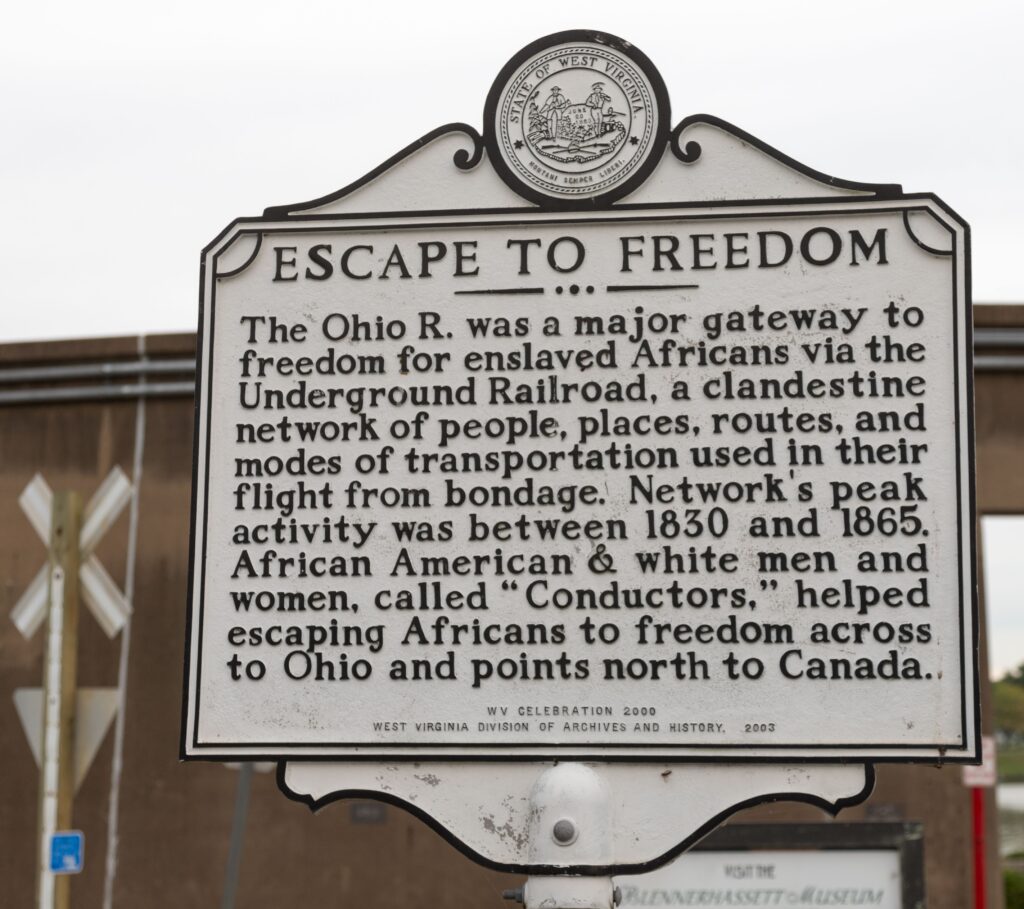
160 years after the Civil War, little-known sites on the Underground Railroad are still being recognized and documented. The National Park Service’s Network To Freedom marker program is a growing collection of documented sites—and some of them are easy road trips from Morgantown.
Created by federal legislation in 1998, the Network to Freedom honors and preserves the history of resistance to enslavement. So far, it lists more than 800 sites that have verified connection to the Underground Railroad. The list includes not only sites where freedom seekers were helped, but also sites they escaped from. As the list grows, it offers an ever-more-granular understanding of the history of resistance to enslavement across the U.S.

A dozen Network to Freedom sites are less than 4 hours’ drive from Morgantown, making them fitting day trips or overnights for Black History Month or any time.
NORTH AND NORTHWEST OF MORGANTOWN
1 hour
F. Julius LeMoyne House
49 East Maiden Street
Washington PA
Medical doctor and philanthropist Julius LeMoyne joined the Washington Anti-Slavery Society in 1834. He and his wife offered their home as a safe station on the escape network for freedom seekers.

1 hour 45 minutes
Mount Pleasant Historic District
Mount Pleasant OH
Beginning in the 1810s, Mount Pleasant, Ohio, was known as a place of refuge for freedom seekers and a welcome place of residence for African Americans. Largely Quaker with a sizable free Black population, the town’s antislavery network maintained multiple Underground Railroad stops. From April to October, you can tour the Quakers’ Ohio Yearly Meeting House—tours by appointment only. Schedule a trip around the Mount Pleasant Historical Society’s annual Friends to Freedom event, the first weekend in August, for tours of multiple Underground Railroad sites.
New Brighton PA
Among sites here related to the Underground Railroad, the home of antislavery activist Robert Townsend is listed on the Network to Freedom. The New Brighton Historical Society hosts a walking tour every other year—the next will be in September 2027—but if a trip in 2026 appeals to you, you can drive by the eight sites listed at the bottom of the organization’s Underground Railroad Walking Tour web page. Although the sites are not open to the public, their histories are available online.

2.5 hours
Haines House
186 West Market Street
Alliance OH
J. Ridgeway and Sarah Grant Haines hid fugitives from enslavement in the small attic room above their kitchen in the 1850s and 1860s, And two well-documented Abolitionist meetings were held in a grove on the Haines farm. The Alliance Area Preservation Society has restorated the Haines House and, operating now as the Haines House Underground Railroad Museum, it’s open the first Saturday and Sunday of each month, March through November.
The Stone Academy
Zanesville OH
The Stone Academy is one of two Network to Freedom sites in Zanesville that are open to the public. It hosted two Ohio Antislavery Society conventions in the 1830s, and it later served as a station on the Underground Railroad. The most popular attraction at the museum that operates there today is a trap door to a crawlspace where freedom seekers hid. The museum houses the Putnam Underground Railroad Interpretive Center and may be toured year ’round by appointment.
Nelson T. Gant House
1845 West Main Street
Zanesville OH
A one-time slave turned entrepreneur, Nelson T. Gant helped others escape enslavement. Tours of the Gant House are available by appointment.

3 hours
Spring Hill Historic House
1401 Springhill Lane NE
Massillon OH
Owned by successive Abolitionist families and operated as a stop on the Underground Railroad for decades, Spring Hill Historic House is open to tours Saturdays June through Labor Day and year ’round by reservation.
NORTHEAST OF MORGANTOWN
2 hours
Allegheny Portage Railroad National Historic Site
110 Federal Park Road
Gallitzin PA
From the 1830s into the 1850s, the Pennsylvania Main Line of Public Works was the primary transportation system between Philadelphia and Pittsburgh. The APRR National Historic Site, located on the 36-mile stretch of the Main Line between Hollidaysburg and Johnstown in west-central Pennsylvania, is on the Network to Freedom and has a visitor center in Gallitzin. You can also read the details of an 1855 escape and pursuit in a series of September 2025 APRR National Historic Site Facebook posts.
SOUTHWEST OF MORGANTOWN
3 hours
Chief Cornstalk Memorial
Tu-Endie-Wei State Park
Point Pleasant WV
The villages of Shawnee natives were key refuges for freedom seekers, offering them shelter, safety, and equal status in their communities in the 1700s, long before Abolitionism became a movement. The Shawnee Chief Cornstalk embodied that spirit, famously refusing to surrender the children of an enslaved woman who had joined the Shawnee. His memorial in Point Pleasant was added to the Network to Freedom in 2024.
The John Gee Black Historical Center at Bethel AME Church
48 Pine Street
Gallipolis OH
When freedom seekers crossed the Ohio River from the Kanawha River valley in western Virginia, Gallipolis was the first town along the way—and Bethel A.M.E. Church, in the heart of Gallipolis’ historic Black neighborhood, became the first stop for many. It was in particular a site of resistance to the 1850 Fugitive Slave Act that authorized the arrest and return of fugitive slaves, including in free states. Housed in the former church building, the John Gee Black Historical Center is open every Friday and Saturday and at other times by appointment.
3.25 hours
Marker: Escape from Green Bottom Plantation
Homestead Road, just south of WV Route 2
Green Bottom Wildlife Management Area, WV
A marker placed at this Network to Freedom location in 2024 honors three enslaved men—Moses, Joshua, and Joe—who escaped from Green Bottom Plantation in Virginia to Ohio in 1819. This location on the Ohio River became an active node of the Underground Railroad, connecting western Virginia with the Abolitionist network in southeastern Ohio. The 1835 Jenkins Plantation home at Green Bottom is currently closed for restoration, but you can explore the wetland boardwalk and other trails in the Green Bottom Wildlife Management Area.
Marker: James Major Monroe’s Escape from Guyandotte
Buffington Street near the Guyandotte boat ramp
Huntington WV
A 2024 marker placed at this Network to Freedom site remembers James Major Monrie, who escaped to Ohio and ultimately to Toronto, Canada, in 1836 after learning that he was to be sold south. In 1838, he returned to help his wife escape, but she was sold before they could meet. His story was published in a monthly Boston magazine in 1841.
READ MORE ARTICLES FROM MORGANTOWN LOWDOWN

Leave a Reply