













You need to kayak Part 3 of 3

This 2022 series was updated in the spring of 2023.
Are you ready for the ultimate Mon River paddling experience? If you’ve followed parts 1 and 2 of this series, you already know what gear you’ll want for kayaking on the Mon and where and how to get your boat in the water. That’s all you need to level up and lock through from one dammed pool of the river to the next. It’s fun and free for everyone—Morgantown Area Paddlers told us how to do it in a few simple steps.


First, to Catch Everyone Up: What, Actually, is a Lock?
Recall that nine dams stair-step the naturally shallow Monongahela River into pools that are always navigably deep, from its mouth at Pittsburgh to its source at Fairmont. Because the reason for the dams is navigation—boats need to be able to pass freely—the engineers built each dam with a lock: a long, narrow chamber with gates at each end that, when water is pumped in or out, floats vessels up to the next-higher pool or down to the next-lower one.
The locks and dams were needed for commerce—most notably for floating barges heavy with Monongahela valley coal to the steel mills downriver. But, as public infrastructure operated by the U.S. Army Corps of Engineers (USACE), the locks are free for recreational boaters to use, too.
Locking through gives a paddler a much more complete feel for the river. And when you experience the lockage process yourself, you get an appreciation for the magnitude of the national project that dammed major rivers for navigation and commerce.

Nature lovers take note: With commercial river traffic down in recent decades, our upriver pools are wilder now than they’ve been in a century. Paddlers encounter beavers, turtles, and all kinds of fish, says Morgantown Area Paddlers organizer Mary Wimmer. They see great blue herons, kingfishers, ospreys, nesting Canada geese, ducks with ducklings, and even an occasional bald eagle overhead, plus all kinds of plant life on the river banks—a retreat into nature just a few paddle strokes away.
When to Lock Through
Each of the four locks on the Upper Mon has its own operating schedule, with fewer hours as you move upriver.
- The Point Marion lock, just over the border into Pennsylvania, and all of the locks downriver to Pittsburgh are open 24/7.
- The Morgantown lock, the one near the Waterfront Marriott, is open 7 days a week from 7 a.m. to 5 p.m.—note that the lock is on the Westover side of the river.
- The Hildebrand and Opekiska locks are open in the summer of 2023 from 7 a.m. to 4 p.m. on June 4, 16, 17, and 18; July 8 and 9; and September 13–17 and 23—and are open at all for recreational boats thanks largely to the fundraising efforts of the Upper Mon River Association, working in cooperation with the USACE and local municipalities.
How to Lock Through
Follow these simple steps, also pinned to the top of the MAP Facebook page. If questions come up along the way, no worries—the lockmaster is happy to help when you call.

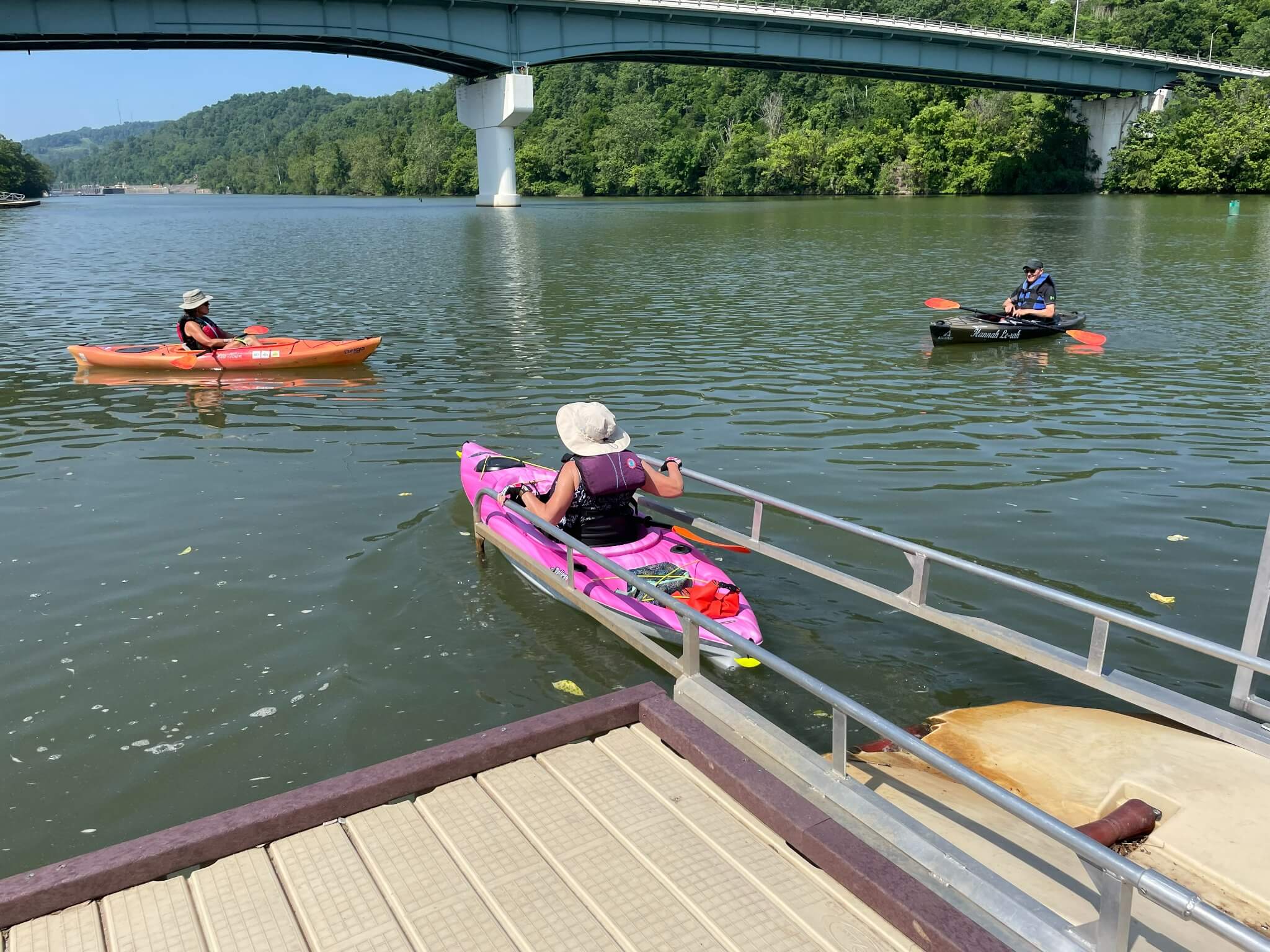


IMAGES COURTESY OF MORGANTOWN AREA PADDLERS
- The boater or group of boaters needs to have a rope or thick strap of 6 to 8 feet and a cell phone, and each boater must wear a life jacket.
- Call the lockmaster by the time you get to the very visibly labeled “Arrival Point”: Point Marion lockmaster, 724.725.5289; Morgantown lockmaster, 304.292.1885; Hildebrand lockmaster, 304.983.2300; Opekiska lockmaster, 304.366.4224. It can’t hurt to call ahead and let the lockmaster know to expect you.
- On approach and departure, stay between the red and green buoys to avoid dam-related currents.
- Follow the lockmaster’s instructions: Stay behind designated points until beckoned, and proceed to the designated floating cylinder in the lock chamber wall.
- Use your line to secure your boat to the floating cylinder, and enjoy the gentle ride as the chamber fills or empties to the level of the up- or down-river destination side. If you’re locking through with other paddlers, one ties on and others “raft together” by holding onto each other’s boats. If more than half a dozen boaters are in the group, more than one cylinder tie-on is recommended. Passage through takes about 20 minutes.


The last lockage is 30 minutes before closing—don’t be late.
Enjoy Our Locks
A fun and easy way to get a first lockage under your life jacket is to do it with the Morgantown Area Paddlers. The group locks through numerous times each year and is happy to have first-timers join in and learn. Paddling trips are posted on MAP’s Facebook page and via MAP’s email list, Wimmer says, usually about a week in advance.
Future lock schedules depend in part on user numbers, she adds. Each passage you make through a lock tells the Corps that this is a resource Upper Mon residents and visitors value and want to keep—so get out and enjoy our locks!
READ MORE ARTICLES FROM MORGANTOWN LOWDOWN