













WVU’s PRT was ahead of its time when it opened 50 years ago—but it looks like the world may be starting to catch up.

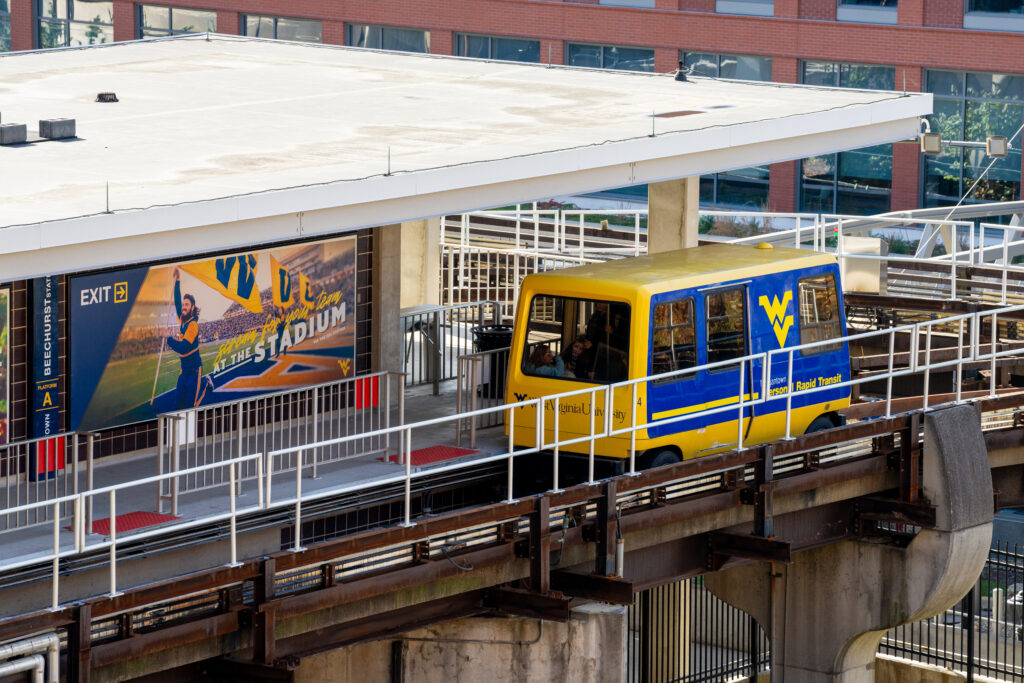
A certain traffic jam in 1965 inspired West Virginia University’s world-famous Personal Rapid Transit system. It was the one Professor Samy Elias got stuck in the day he moved to town to teach industrial engineering—or so goes the local lore.
It might be true. “In the 1960s and ’70s, traffic jams would block the whole city,” says Jim Hatcher, who was a graduate student at WVU in the mid-’60s. “I’ve got photographs I made through the windshield of my car at University Avenue and Campus Drive, 45 minutes into waiting for something to move somewhere—and that was not uncommon.” On Campus Drive, he says, coming up the hill from Beechurst toward University, the stop line was a big yellow bar painted on the road well back from the intersection. “The reason was, the buses had to turn there. If the bus couldn’t turn, everything out to Star City stopped. It was incredible.”


Whatever complaints you have about traffic in Morgantown today, there hasn’t been citywide gridlock since the PRT first opened to public ridership in 1975. The system was a completely new idea in public transit and, 50 years later, that idea may be catching on.
Compact city, outsize traffic
Already sprawled across three campuses by the mid-1960s, WVU ran the second-largest university-operated bus fleet in the nation, carrying more than 265,000 passengers each month. The traffic during a class change could be day-ruining. It took an hour to travel the mile and a half from one campus to another, the joke went—whether you drove, rode the bus, or walked.
The university was growing, too, both in enrollment and as an events destination. The Creative Arts Center opened in 1969, then the Coliseum in 1970, bringing lots more people to town for entertainment and sports.


But Professor Elias had a visionary idea. He was interested in automated guideway transit: computer-controlled mass transportation that, by routing vehicles non-stop to their destinations, would combine the efficiency of public transit with the on-demand, point-to-point convenience of the automobile. It was a holy grail for transportation planners, an ideal that had never yet been tried.
Elias proposed that a system of six stations—Walnut Street, Beechurst, Coliseum, Engineering, Towers, and Medical Center—would allow the university to take the buses off of the streets and persuade some students to leave their cars at home. And in August 1970, the WVU Board of Regents submitted a grant application for Elias’s idea to the U.S. Department of Transportation (DOT).
Timing is everything. The booming post-war decades had led to urban congestion everywhere, and U.S. Transportation Secretary John Volpe wanted to make his mark. At the same time, West Virginia had a powerful presence in Washington. Morgantown’s congressional delegation, including the influential Senator Robert C. Byrd, all sat on committees that controlled Volpe’s budget, and that meant leverage.
The DOT granted $13.5 million toward a six-station automated guideway transit installation that WVU believed would cost, in total, about $18 million. For Volpe, it was a dream. “We will come up with a system of transportation that people will use, that will ease traffic congestion, will cut down on the rapidly increasing volume of auto exhaust pollutants, and will set the pace for the nation,” he enthused on announcing the grant. Morgantown’s rugged topography, icy winters, and multiple student rush hours each day made it a choice test location for a demonstration project, he said.


Ramping up
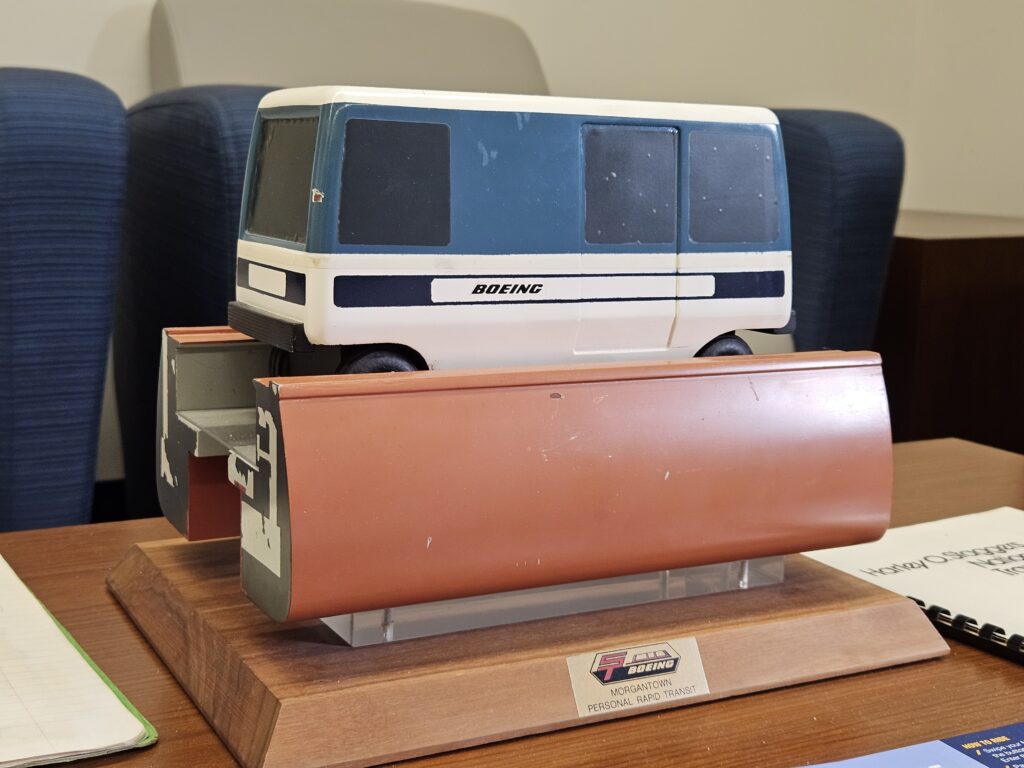
Becoming a federal demonstration project brought big money and big expertise to the PRT—and big changes. The DOT wanted a working system before the 1972 presidential election, putting design and construction into high gear. Also, the government’s project manager, the federal Jet Propulsion Laboratory, estimated a much higher cost of $37 million. So a smaller, cheaper Phase 1 was carved out to slim the budget and meet the deadline: three stations, at first, instead of six all at once. Also, fewer, larger cars that would carry 21 passengers rather than many that would carry only six. It would all be OK: The contract assured the university that, if the system did not fulfill the original intent, the government would remove it.
Progress was slow. The DOT did hold a dedication to boost President Nixon’s image with urban voters before the November 1972 election—although the dignitaries in attendance were only able to travel between Engineering and the PRT maintenance building at 8th Street. It was early 1974 before Phase 1 finally neared completion. Guideway connected stations at Walnut Street, Beechurst, and Engineering. Five test cars traveled the guideway, with 40 more under construction. The government would put the system through a trial year of ridership and turn Phase 1 over to the university in April 1975. It was all on track.
Then, on March 16, 1974, Business Week ran a story that derailed everything.
The PRT’s accelerated timeline had forced the contractors to build the project while it was being designed, the story said, leading to huge cost overruns. Because the engineers didn’t know the weight of the cars, in an example that came out later, they had made the guideway far stronger and heavier than necessary—and far more expensive.
The Morgantown PRT was supposed to be six stations at a cost of $37 million. Now it was three stations at a projected $64 million—and $115 million or more for all six. It had become “a research and development nightmare that may actually set back PRT development instead of fostering it,” the story said.

Guideway or the highway
Quiet, behind-the-scenes haggling between the university and new leadership at the DOT suddenly escalated into a very public game of chicken—with the entire project on the line.
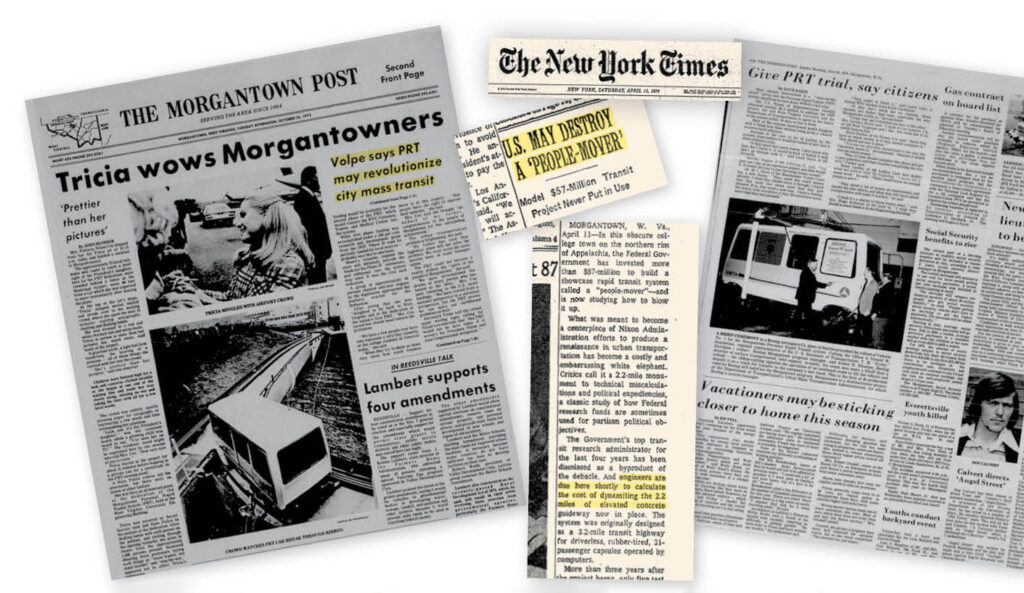
“Engineers are due here shortly to calculate the cost of dynamiting the 2.2 miles of elevated concrete guideway now in place,” read an April 13 New York Times story under the page 1 headline “U.S. May Destroy a ‘People-Mover.’” DOT officials had learned all they wanted to from the project. They were weary of cost overruns, the story said, and wanted to hand it over to WVU and be done.
But the university didn’t want the half-system. Let them dynamite it, WVU President James Harlow basically told the newspaper. “We’re quite willing to have it removed,” he sniped. “Because of political considerations, we’re so far removed from the original concept … that all we have left is a test track for some hardware.”
National media outlets piled on: NBC News, U.S. News & World Report, and The Chicago Tribune all took their shots over the following weeks, and The Wall Street Journal ran a cheeky “Little Engine that Couldn’t” headline.
There’s nothing like the threat of losing something to make it appealing. Residents now defended a system they’d been doubtful about. “Since they have so much money in it, they should complete it,” said one in a man-on-the-street poll in The Dominion-Post. Three stations are better than none, said another. “Especially the way Morgantown traffic is.”
In June 1974, tired of the standoff, the U.S. House appropriated $6.3 million to complete Phase 1—but with an ultimatum: Figure Phase 2 out in detail by mid-September, or use this money to tear the thing down.

Bumper Cars
Back-and-forth bluster about dynamite is one thing, but language that ends up in the federal budget becomes law—there was now a very real possibility that the PRT would be demolished by congressional mandate before it ever opened to the public. Our delegation in Washington scrambled to bridge the gap.
At a July budget hearing chaired by Senator Byrd, a less defiant WVU President Harlow argued for completion. A three-station system would generate 3.5 million passengers a year and require a $500,000 annual subsidy, he explained—but six stations would generate 14 million passengers a year and be self-supporting. The university did not want to see the system razed, he assured the senators, and remained committed to the project.
Meanwhile, negotiations over Phase 2 continued. The university thought maybe it could live without the Coliseum station. The DOT thought maybe it could pay for a scaled-back second phase. But there were too many details to work out by the House’s mid-September deadline. Byrd tried to remove the time limit but, for two suspenseful days in August, House members stood their ground. Finally, on August 14, the language was removed from the budget bill. “Phase 1 gets completed,” Harlow told The Dominion-Post with relief.
It wasn’t until April 1975 that the parties came to detailed agreement on Phase 2 of the PRT—a year after the Business Week story that set the whole thing off.

All Aboard!
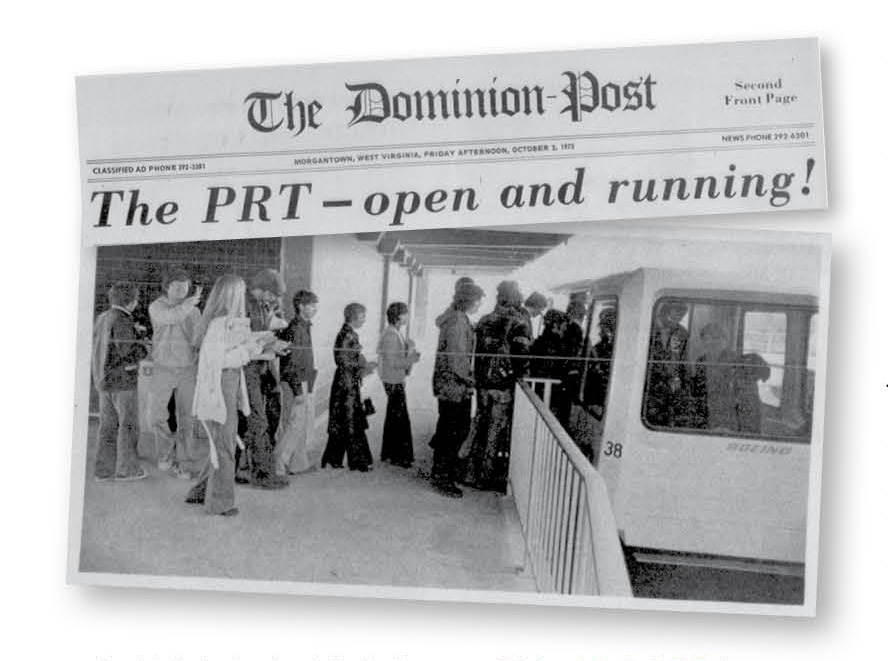
The last hours of a years-long wait played out on the morning of October 3, 1975, in lines at the Walnut Street, Beechurst, and Engineering stations. It had been a long time coming—freshmen who’d attended the October 1971 groundbreaking had already graduated. And in July 1979, after a yearlong shutdown for Phase 2 construction and testing, the full five-station system opened to the public.
Hatcher—the one who took the photos of gridlock through his windshield—was hired on as a PRT control room operator as Phase 2 was wrapping up in 1978. “We tested all of the electronics and all of the software—the most boring thing in the world, but it has to be done,” he says. It took nearly a year. “Every wire has to start at a defined place and end at a defined place, and we checked every one of them.”
Retired today, Hatcher served in a variety of capacities at the PRT over three decades—
control room supervisor, systems programmer, safety officer, operations manager. “My job there at its essence was knowing everything possible about the control system and how to keep it running for years and years.”
One of Hatcher’s tasks was to keep statistics on system performance. Subtracting downtime from scheduled operating hours, he tracked system availability. “That figure was consistently higher than 98.5% on a monthly basis,” he says. “What that meant was, if you marched into a station to take a ride at a random time, the chances were 98.5% that you would have a totally uninterrupted trip.” Availability dipped in the mid-’90s and, in 1996, he oversaw an emergency upgrade that rehosted the PRT control system on a new platform and restored a high level of system availability.
Actually, it’s GRT
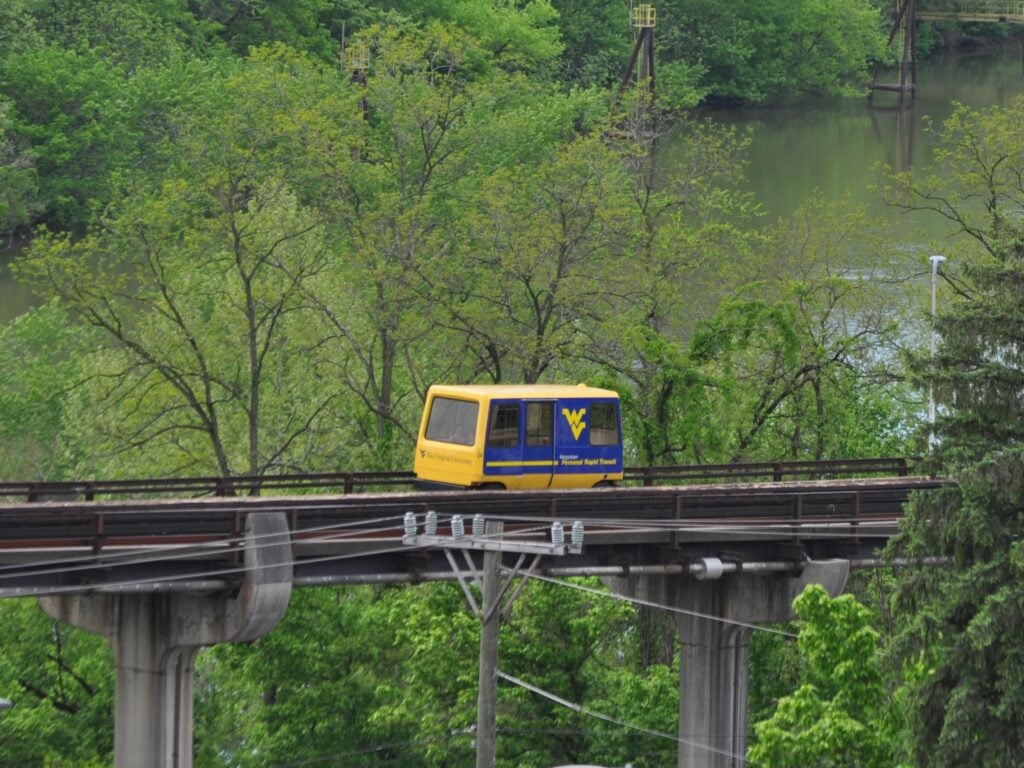
The initial 1970 design of the WVU transit system was, by definition, a personal rapid transit system: automated cars of six or fewer passengers going point-to-point. At that early stage, the Morgantown media didn’t call it personal rapid transit—the newspapers called it a “people mover,” the household-familiar name of the Tomorrowland transport attraction that had opened at Disneyland in 1967. In 1971, the design of WVU’s system changed to 21-passenger cars, which makes it, technically, group rapid transit. But around that time, the press caught up to the previous design phase—everyone started calling it the PRT, and it stuck.
Rolling along
Jeremy Evans came on at the PRT in early 2018. That summer, the wires Hatcher spent a year checking 40 years earlier were cut—the PRT went wireless. Evans saw a control room with 1970s-vintage electric switch panels upgraded to a wall of LCD screens. New RFID scanners would track the position of every car in detail, and cameras were installed to monitor all of the stations and the entire guideway.
Now director of Transportation, Parking, and Mail Services, Evans promotes a culture of continual improvement. “We look at our top five causes of downtime every semester and say, ‘What can we do to bring those down?’ ”
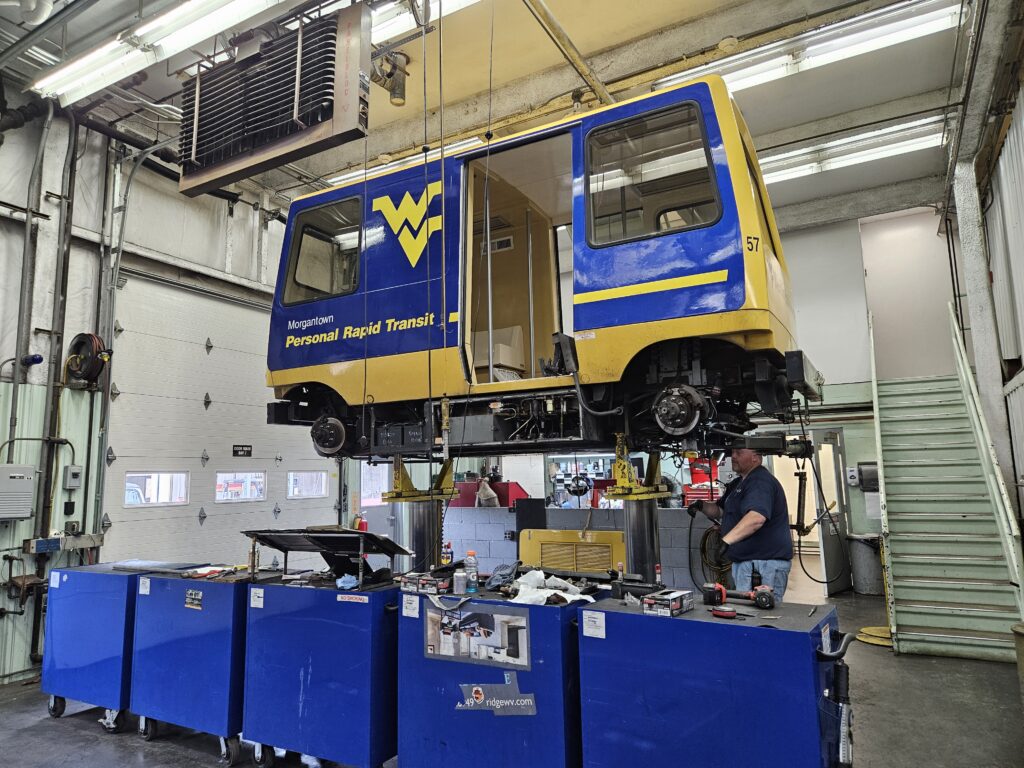
Vehicles sometimes used to track a little sideways and pull themselves out of the power rail, for example. Around five years ago, Evans’ team figured out it was because the sidewalls of radial tires couldn’t always handle the weight of a fully loaded vehicle, and they replaced those with trailer tires. “That issue’s gone away for us.” Later, the installation of heat-sensing cameras on a vehicle made it possible to identify problems on the power rail before they become serious.
“The guys have done a really good job of coming up with new ways of inspecting and maintaining the system,” says Evans. “We have a really good staff here, and they want the students and the public to have a very good experience. They take a lot of pride in that.”
PRT availability has again run close to 99% in recent years, as it did in the ’80s and ’90s. Yet, over the decades, students have found fault. Hatcher thinks it’s in the nature of transit riders. “If it fails for you one time out of a thousand trips, the system is a failure in your mind.”
Evans sees it similarly. “ I would put our availability numbers against any other transit agency in the country,” he says. “But if you’re on the PRT and it goes down for 20 minutes one time, you think, ‘Oh, this thing looks old,’ and you just assume that it doesn’t run well. That one bad experience is foremost in your mind—not the thousand other times that you had no issues. And that spreads like an urban legend.” He offers advice that applies to users of public transit everywhere: “Plan for an extra 15 minutes.”
At 12,000 passengers a day during the school year, the PRT is still keeping lots of cars off the road. A round of functional and aesthetic upgrades is underway now. PRT staff are currently working on grant-funded renovations that include painting guideway piers, installing new elevators, and modernizing stations.
Coming back around
After the very public 1974 showdown between WVU and the DOT, automated, on-demand, point-to-point public transit lost its holy grail status. Although WVU’s system has been studied over the decades by transportation planners from across the nation and around the globe, it’s still the longest of the handful of such systems that ever got built. Business Week may have been right—the Morgantown brouhaha set PRT development back so badly that no one has wanted to touch it since.
But Evans sees the idea coming back around. Glydways of California is in advanced talks with several cities to create guideway systems for its four-passenger autonomous, on-demand, point-to-point Glydcars. Autotrén of Guadelajara, Mexico, has submitted proposals for similar systems carrying its vehicles for six or eight passengers.
And as the technology for self-driving vehicles matures, new possibilities open up. “People always ask us, are you going to expand the PRT? We’d love to,” Evans says. “Why couldn’t we have a vehicle that we take on the guideway and also take off of the guideway into a dedicated lane, or maybe even into mixed traffic? That would allow us to expand our footprint without having to build the big infrastructure.” It’s probably a $100 million project, he says—far, far less than the original PRT cost, when you account for inflation.
Self-driving vehicles that use both city streets and elevated paths is a concept that has some traction. On June 30, the Jacksonville, Florida, Transportation Authority launched NAVI, the nation’s first public driverless transportation service. In the next phase, the transportation authority will convert its existing monorail Skyway for use by the driverless vehicles, creating a system of autonomous vehicles that runs on both.
So we may be on the cusp of an era of automated transit that’s even richer than the one envisioned by Elias and Volpe, one in which cities can customize their systems from an unprecedented range of vehicle and path types. Half a century ahead of its time, WVU’s PRT will always be the first of them—the system that, as Volpe said, set the pace for the nation.
Packed Rapid Transit
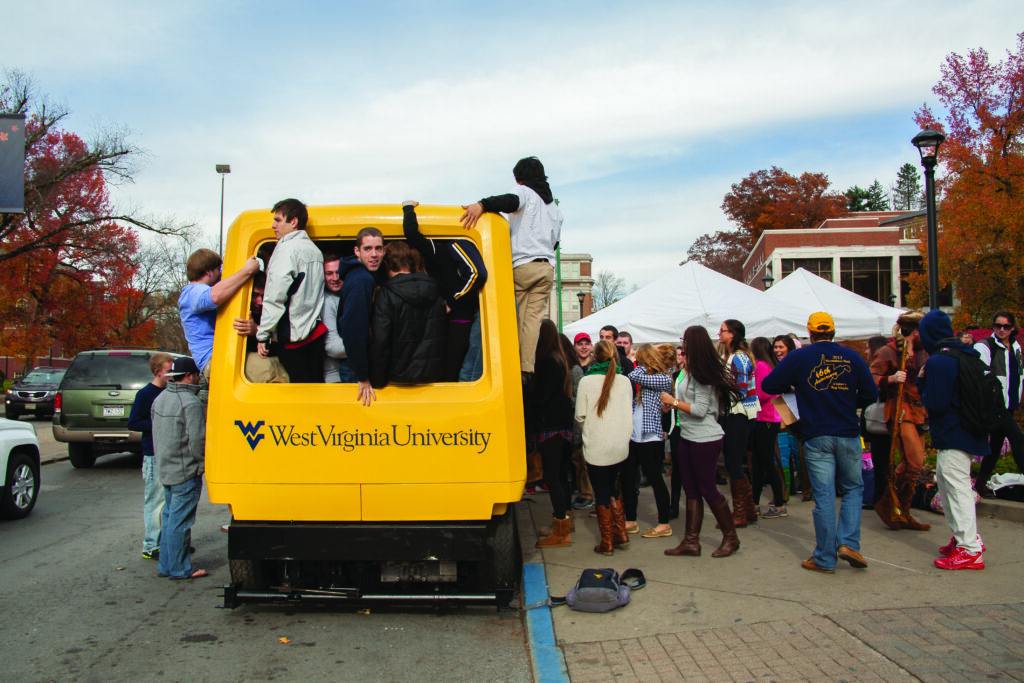
Before the COVID-19 pandemic, one of the most anticipated Mountaineer Week events was the PRT Cram, in which students tried to get more people into a PRT car than ever before. The record, set in 2000: 97.
READ MORE STORIES FROM OUR FALL 2025 ISSUE