













The Coopers Rock climbing community is growing as fast as new routes and world-class climbing opportunities are being discovered.

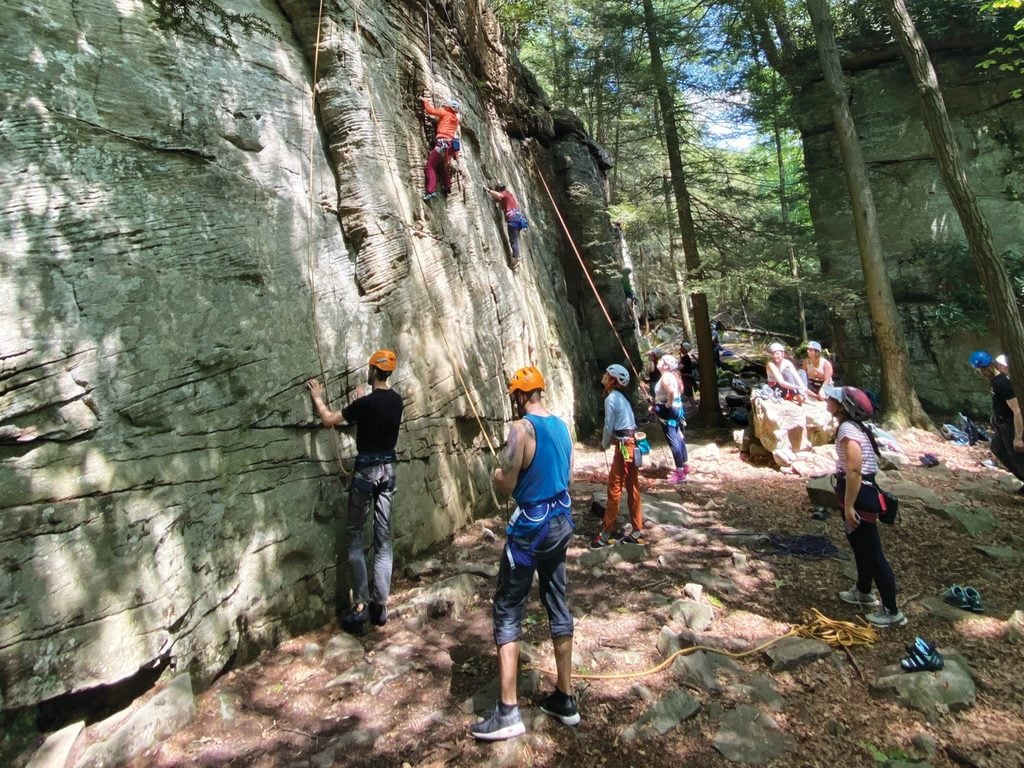
Coopers Rock’s cliffs and boulders hide beneath the tree canopy, but they’re hardly a secret. In fact, the state forest is a popular destination for climbers, and a healthy community of adventurers has come together to call it home.
“What makes Coopers Rock unique is the sheer concentration of rock,” says Mike Paugh, owner of Ascension Climbing Guides in Morgantown. “The cliffs aren’t tall like those in the New River Gorge or Seneca Rocks, but there are hundreds of roped climbs and tons of boulders scattered throughout the forest. And the rock is gritstone, a highly friction-based sandstone.”


This type of rock is found in just a few places in the world, Paugh says.
Rocking Coopers
Paugh started climbing around 2000 and became especially interested in its technical side—rope systems, anchors, and safety. Getting certified as a guide was a natural step, and he guided at both Seneca Rocks and in the New River Gorge.
“When I moved to Morgantown in 2007, I found a really welcoming outdoor community,” he says. “There are paddlers, climbers, hikers—people who are passionate about recreation because they have incredible resources in their backyard, everything from the Cheat River to Coopers Rock.”


He launched his own guiding service, Ascension, in 2020. At the time, he saw it as an opportunity to bridge the gap between indoor climbing and outdoor climbing, since many climbers today start in gyms. These controlled environments are an accessible way to learn the basics, but moving outside requires a different skill set. Climbers need to understand anchor systems, rope management, outdoor ethics, Leave No Trace principles, and how to safely navigate natural environments.

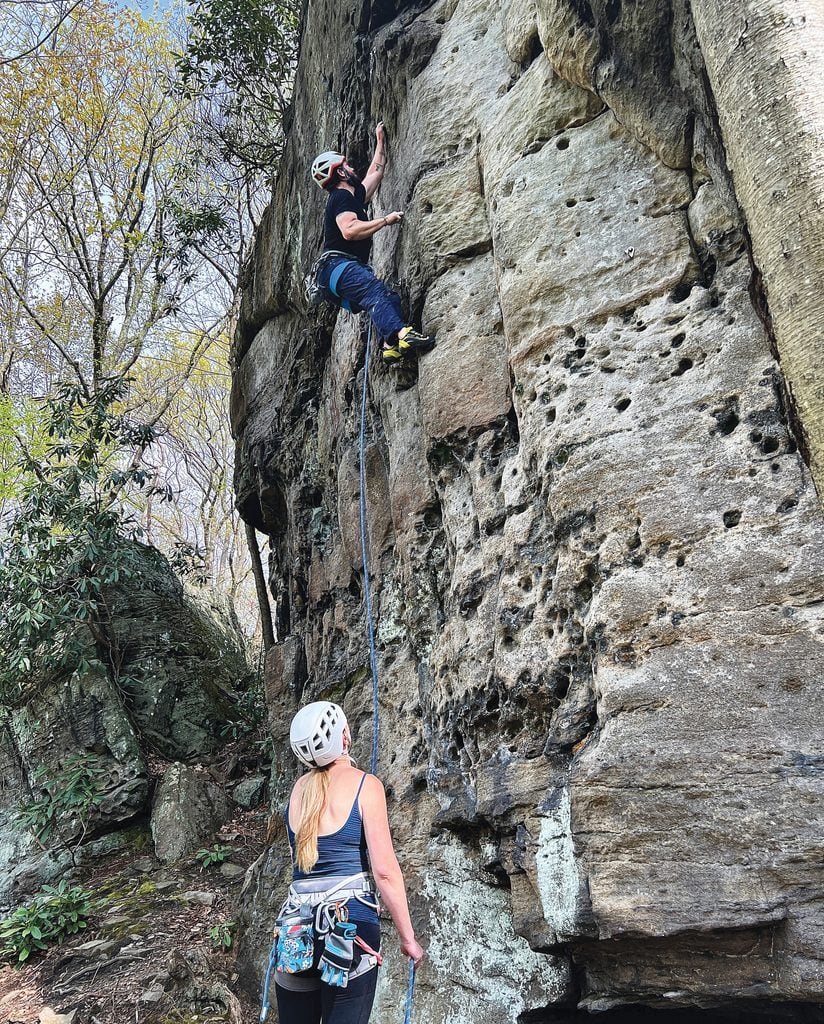
“That’s really where Ascension comes in,” he says. “Some clients are complete beginners who just want to experience climbing for the first time. Others have larger goals and want technical instruction.”
Many of his clients have never rock climbed before and simply want a local adventure. “Maybe they’re driving through Morgantown or camping up at Coopers Rock—those are the majority of calls I get. They’re looking for a little excitement outside. That’s why I love instructing—seeing the joy people get stepping out of their comfort zone and discovering what they can truly do.”

Paugh says Sunset Wall is one of the most popular climbing areas. It has cliffs around 35 to 40 feet high and routes that are approachable for beginners while still offering challenges for more experienced climbers. Another of his favorite areas is Rattlesnake Point, which is heavily forested and tends to be quieter.
His instruction focuses heavily on safety and technical skills. He covers things like anchor building, top-rope systems, rope management, and, for more advanced climbers, traditional climbing techniques.
Nevertheless, most of his clients aren’t looking for advanced instruction—they simply want to try climbing for the first time and experience something new.
Usually, it’s about adventure and pushing personal boundaries.
Regardless of why climbers are on the rock, Paugh says the strong and welcoming community continues to grow, year by year. “People are passionate about climbing here. Coopers Rock is the centerpiece of it all.”
Hang With a Friend
If you’re climbing at Coopers Rock, there’s a decent chance you’re going to run into Beth Hestick. Now in her 70s, she learned to climb back in the 1980s after seeing a magazine photo of a woman climbing. The article listed three places to learn to climb: Yosemite, the Grand Tetons, and Seneca Rocks. She chose Seneca Rocks, and still climbs there—but Coopers Rock is close to her home near Morgantown, and it’s been the center of her climbing universe ever since.

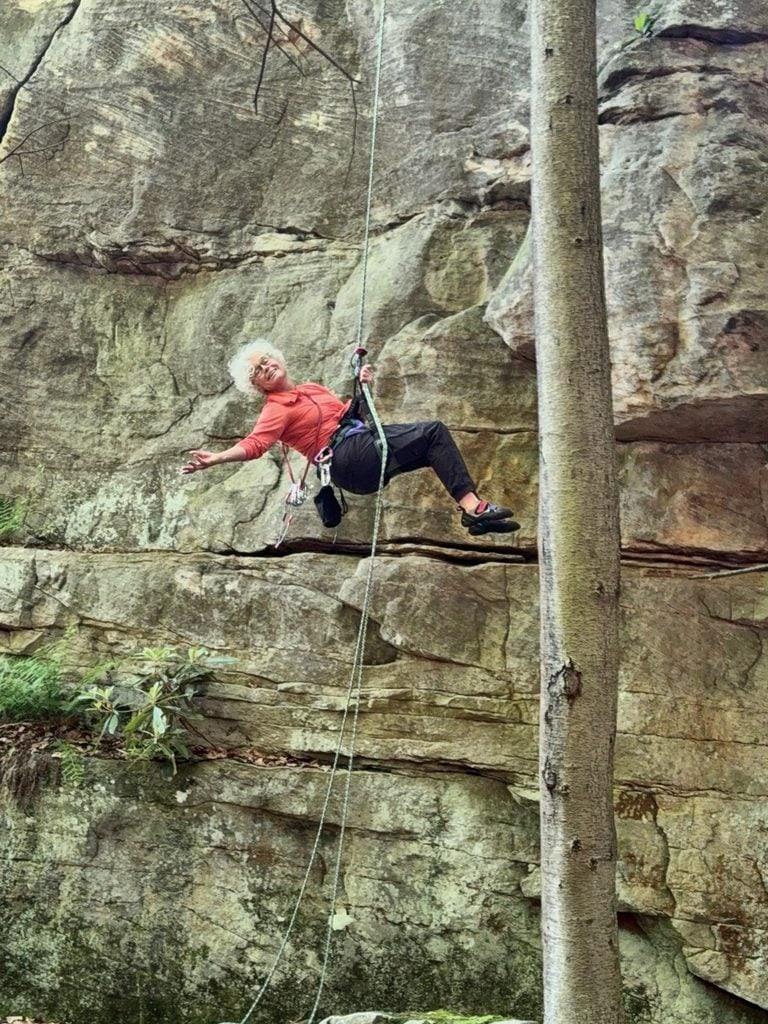
“Back then, it was very obscure—there weren’t a lot of people who climbed,” she says. “My role there? I don’t know, I just climb.”
In the years since, the climbing community has grown by leaps and bounds. She once felt like the only woman on the rock, but now she’s one of many. “There’s a group of women who climb together on Thursdays. We often climb at Coopers, and sometimes at other local areas or in climbing gyms around Pittsburgh if it’s raining.”
There are hundreds of climbs at Coopers Rock, and various types of climbing, too. Top-roping—where the rope runs through a fixed anchor at the top of the route—is common at Coopers Rock, but it’s known first and foremost as a mecca for bouldering. Climbers make their way up small rocks and walls without ropes or harnesses, usually laying mats or crash pads below in case of falls.
While plenty of formal instruction opportunities exist, Hestick enjoys teaching on her own. She’ll take friends out to experience what she loves so much about the sport. “Climbing has been such a positive part of my life,” she says. “When you’re climbing, the only thing you can think about is climbing. Your brain clears out. You can go in sad, depressed, or anxious and come out transformed. I want people to experience that.”
She especially enjoys the social side of Coopers Rock climbing. While two people may begin a climb together, a group may gather as the day goes on. “You watch each other climb, talk, make new friends, and reconnect with old ones.”
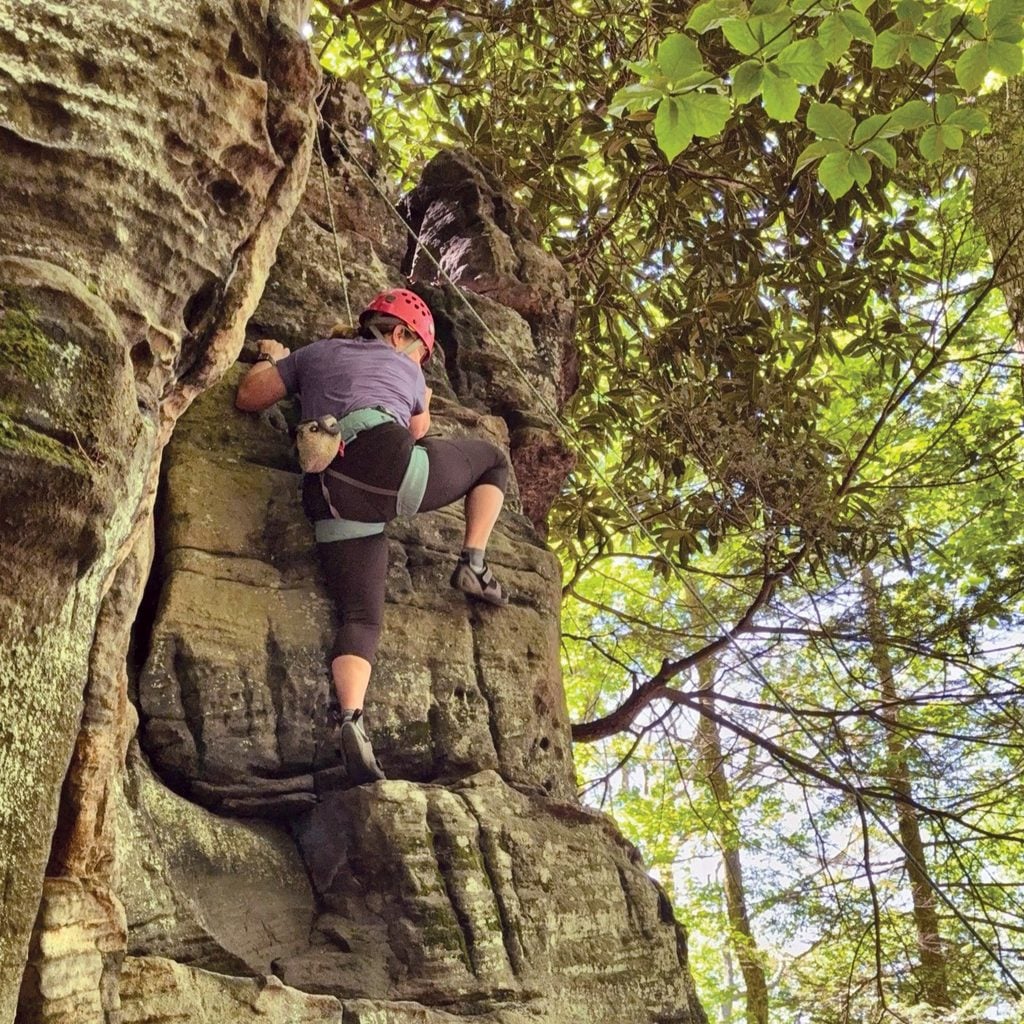

It’s not necessarily a young person’s game. Climbers of all ages find their way up the mountain, though younger climbers tend to be more interested in bouldering. In fact, people come from all over to boulder at Coopers. It’s nothing to run into climbers from Washington, D.C., Cleveland, or elsewhere who have come in for the weekend.
Hestick still climbs many of the same routes she climbed 30 years ago, but she works out much more now to maintain her strength so she can spend time on the rock.
“Coopers is my happy place. It’s a huge part of my life, and I love it there.”
Cheat Canyon Bouldering: Volume 1—Coopers Rock
by Andrew Leich
“Bouldering is the athletic pursuit of climbing,” says author Andrew Leich, a veteran Morgantown-area climber. “Probably 90% of climbers boulder. It’s the best way to train for bigger objectives. Just shoes, chalk, and a crash pad is all you need to wander around the forest and have a good time with friends.” Cheat Canyon Bouldering contains:
- more than 2,500 boulder problems
- 2,100 previously unpublished lines
- color photos, detailed maps, GPS coordinates, and suggested circuits
- guide for first timers and seasoned locals
Also by Andrew Leich, Cheat Canyon Rock covers 477 routes across 37 crags in the greater Cheat Canyon area. Both guides are available at cheatcanyonrockclimbs.com
READ MORE STORIES FROM OUR FALL 2026 ISSUE