


The Flight 93 National Memorial in southwestern Pennsylvania gets a final, poignant touch this September.
On the morning of September 11, 2001, news programs had just started speculating about the bizarre 8:46 crash of a plane into the North Tower of the World Trade Center in New York City when the 9:03 crash into the South Tower put things in a very different light. President George Bush quickly labelled the crashes “an apparent terrorist attack.”
That news was filtering into offices across the eastern U.S. and waking homes in the west when a third plane crashed—into the Pentagon in Washington, D.C. For the first time ever, the Federal Aviation Administration ordered all flights to land.


That unintended crash site less than two hours’ drive from Morgantown was declared a national memorial by Congress in 2002. This September, the memorial will be complete.
A Field of Honor


Flight 93 smashed into the ground at nearly 600 miles per hour, shattering the plane and its contents and spreading debris over a vast area. The Flight 93 National Memorial is not a stone monument marking a spot or a series of plaques at an overlook, but a park memorial laid across the landscape, giving visitors the scale and perspective they need to take in the enormity of the event.
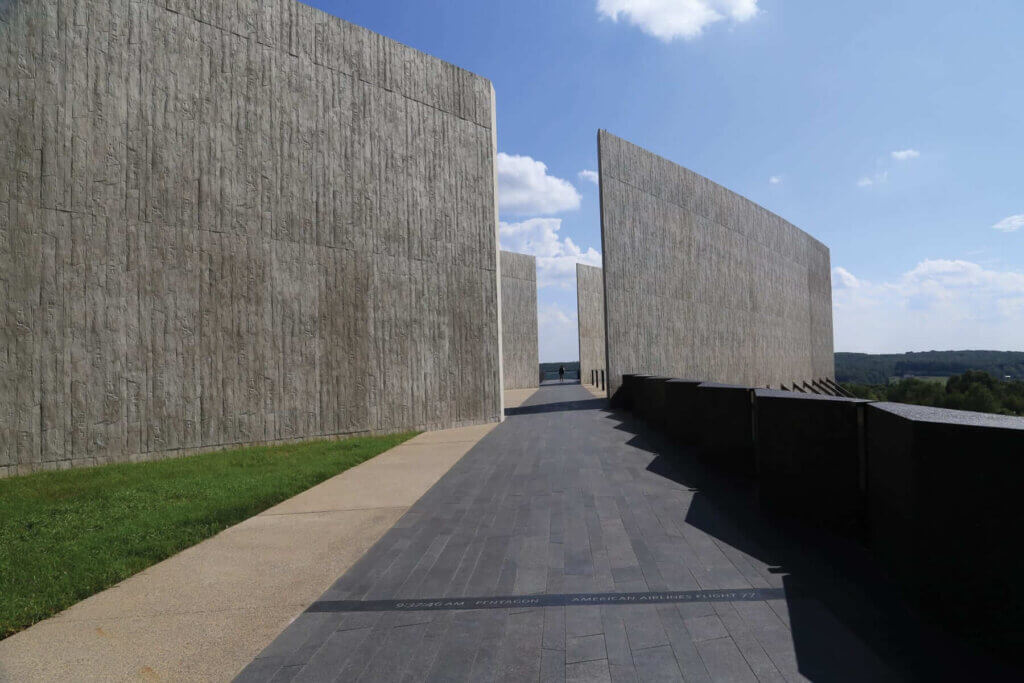
Entry to the site is on the Flight Path Walkway, a gash of black granite that follows the northwest-to-southeast path the plane flew as it dropped hard toward the ground. Markers along the path document the times of the three earlier crashes. The walkway passes through breaks in two high walls, then ends abruptly at a wide window overlooking the crash site and debris field a quarter-mile away below the ridge. It’s architecture and design in service of the experience: Following the flight path, recalling the timeline, crashing symbolically through the walls, then stopping suddenly works as an analog for the last moments of the lives of the passengers of Flight 93.
Beside the walkway, the Visitor Center gives a multimedia presentation of the moments leading up to that end.


We can’t know everything that happened on that plane. But through interviews with ground control and passengers’ families and the information from the flight data and cockpit voice recorders, investigators pieced together a fairly detailed picture. The museum exhibits let visitors assemble their own views of the events.
The last couple hundred feet of the flight path make up Memorial Plaza. A Wall of Names identifies each of the victims. The path ends at the debris field and looks toward a boulder that marks the spot where the nose of the plane hit the ground.
As a landscape memorial, the 2,200-acre national park lets visitors take the crash in in their own ways: emotionally or intellectually; from a distance or up close; as a singular event, as part of a national tragedy, or in the context of global tensions.
The final touch
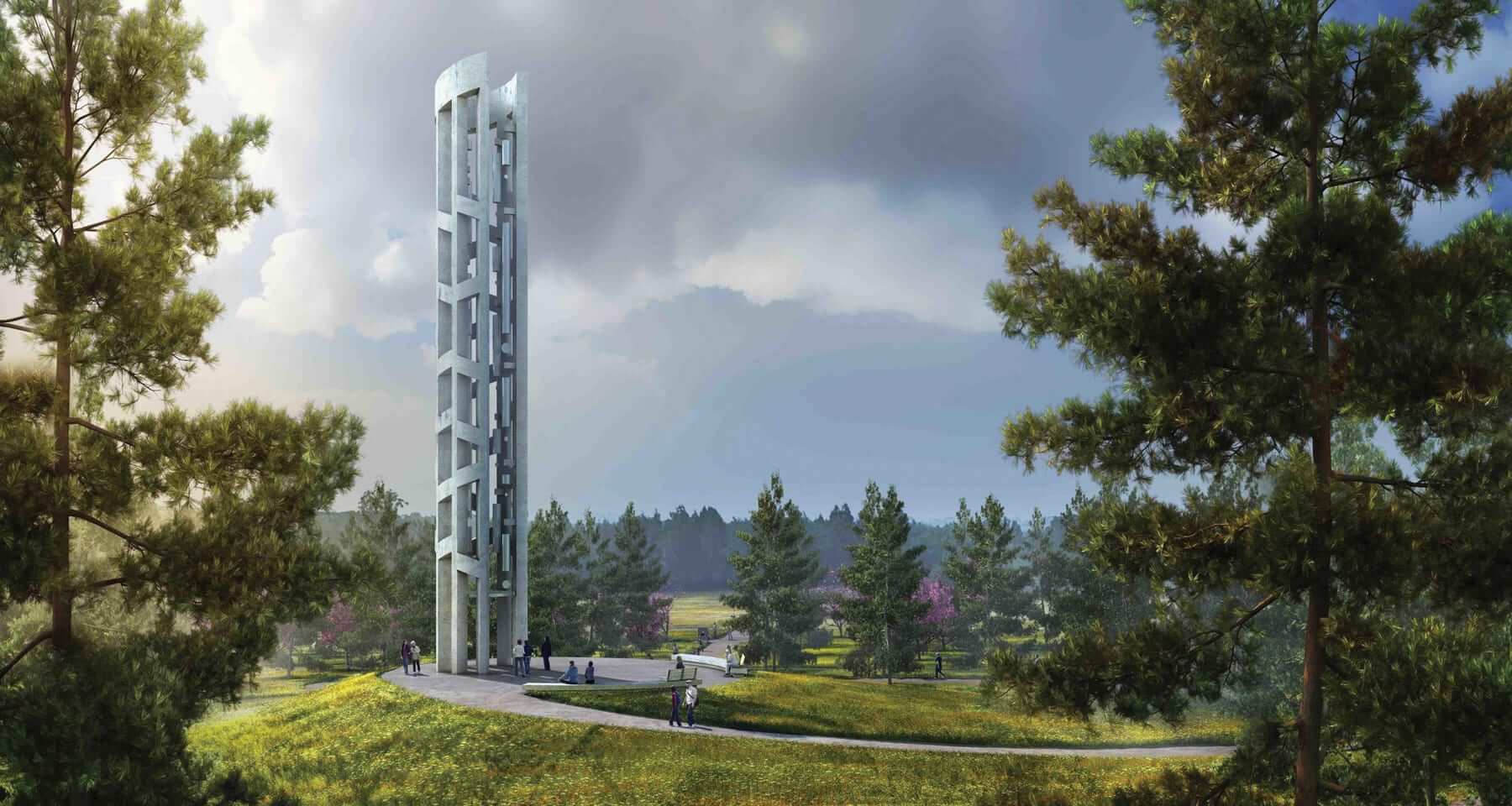
The Flight 93 National Memorial is not yet quite complete. This September, the National Park Service will dedicate the Tower of Voices, a 93-foot monument containing 40 wind chimes meant to echo the voices of the passengers and crew—a lasting tribute in sound. The tones are chosen to convey the serenity and nobility of the site, according to the National Park Service website, “while also through dissonance recalling the event that consecrated the site.”
The tower will be dedicated on Sunday, September 9 at 1 p.m. To hear a Tower of Voices wind chime simulation, visit goo.gl/DqFncd.
6424 Lincoln Highway, Stoystown, PA, 814.893.6550, www.nps.gov/flni/index
written and photographed by Pam Kasey